
Crawl Space Encapsulation in Asheville
Crawl space encapsulation in Asheville seals the space under your house: we shut the vents, line the dirt and walls, and add a dehumidifier. It ends the musty smell and damp joists, leaving a dry, sealed crawl space. You see the cost before you commit.
Where do I start if I think the crawl space is damp?
Start at the access door with a flashlight and look at the dirt, the plastic and the insulation. Wet soil, torn or missing plastic, and batts sagging from the joists all point to damp. If the ducts sweat in summer, humid air is getting in through the vents.
Can I start with just the ground cover?
Yes, and it stops the moisture rising from the dirt, but open vents keep letting humid air in. In summer that air condenses on the ducts, pipes and joists, covered dirt or not. A crawl space with a new ground cover and open vents can still smell musty. Closing the vents and drying the air is the part that finishes the job.
What do you look at first under the house?
We look first at where the damp is coming from: the vents, the bare dirt and any standing water. That tells us what to fix before we lay the liner, so you end up with a dry crawl space. We also check the joists for moisture, the plastic that's down now and the headroom.
Where the damp under your floor comes from
Damp gets in two ways: through the foundation vents, and up from the ground under the house.
The vent air does its damage in summer. Warm, humid air drifts into the cool crawl space and condenses on the ducts and subfloor. With the vents open, the humidity outside sets the humidity under your floor.
Bare dirt adds moisture all year long. Even when it looks dry on top, it gives off water vapor that rises into the joists, and torn plastic barely slows it.
You usually notice it upstairs first, as a musty smell or a soft spot in the floor. Under the house, it shows up as insulation hanging from the joists, mold on the wood or droppings by the access door.
Why we close off both
Closing the crawl space in handles both. We shut the vents so outside air stays out, and we cover the dirt so ground moisture stays under plastic. The trade calls the result a closed crawl space, one sealed off from the outdoors.
Shut the vents and leave the dirt bare, and the ground moisture gets trapped inside. Cover the dirt but leave the vents open, and muggy air keeps pouring in. So we do both, then dry whatever air is left.
A mobile home works the same way, since the space behind the skirting is a crawl space too.
Not every crawl space needs encapsulating. If the dirt is your only worry, we lay a new ground cover as a job of its own. When drying the air is all that's left, we set up a dehumidifier sized for the space by itself.
The order we do the work in
We work from the ground up. Sealing over water or old debris just traps the problem.
- We deal with the water. If water pools after storms, we set a sump pump in a pit at the low spot to push it out. Water running in from the yard is a waterproofing job we sort out first.
- We clear it out. We bag the old plastic, fallen batts and debris and carry it out the access door. With a big mess, we start with a full crawl space clean-out.
- We seal the openings. We close the vents with waterproof covers and seal gaps around pipes and wires with caulk or foam. That includes the rim joist, the board running around the edge of the floor framing.
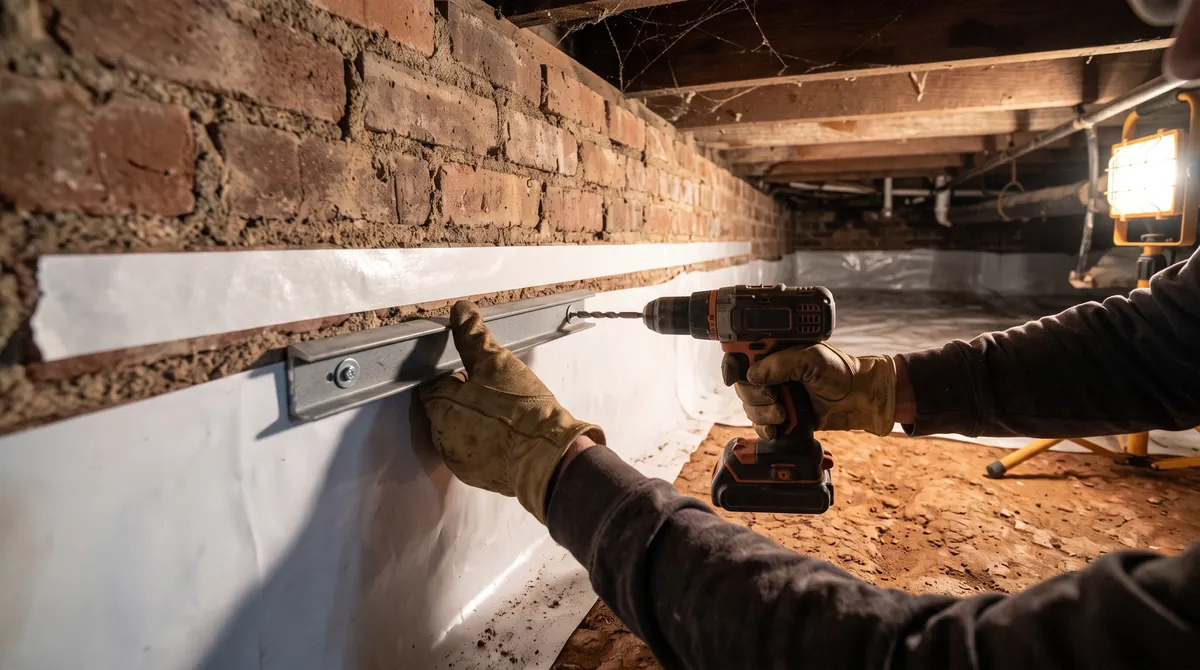
- We lay the liner. We roll heavy plastic over the dirt, overlap and tape the seams, and run it up the walls and piers. Piers are the masonry columns under the middle of the house. A termination bar, a strip screwed into the wall, holds the top edge tight.
- We dry the air. We put in a permanent dehumidifier, since a sealed crawl space needs drying for good. Its water leaves through a drain line or a condensate pump, a small pump that lifts it outside.
- We check it. We read the humidity and test the joists for moisture, so you can see the space holding dry.
Can you repair a liner that's already down?
Yes, we patch or replace the torn sections and reseal any edge that's pulled loose from the wall. Joists that have gone soft need a framing repair, and we'll show you any we find.
What drives the price in your estimate
Most of the price comes down to six things.
- Size. Square footage sets how much liner we use, so a price per square foot tells you only part of it.
- Room to work. A low space behind a small access door takes longer than one you can kneel up in.
- Water. Standing water, a sump pump or drainage outside comes first and adds to the job.
- What's down there now. Old plastic, fallen batts and junk have to come out before we start.
- Drying the air. A dehumidifier with a drain line costs differently from one needing a condensate pump. Some houses use supply air from the AC or an exhaust fan instead.
- The permit. Converting a conventional crawl space to a closed crawl space takes a permit regardless of cost. Even a small job carries one.
What sealing does about radon
A sealed liner helps with radon, but it doesn't replace a radon test. The unbroken liner slows soil gases coming up with the moisture.
Radon is common around here. The U.S. Environmental Protection Agency designates Buncombe County a Zone 1 county, meaning the average home will test over 4 picocuries per liter. That makes a test on your house worth doing, before or after we seal.
If the test reads high, a radon crew can add sub-membrane depressurization. That's a fan and pipe pulling air from under the liner and venting it outside.
If you're building new, it's simpler. The builder can make the house resistant to radon from the start, and we line and seal the crawl space before anyone moves in.
Where spray foam fits once the vents are shut
Once the vents are shut, insulation usually moves from the floor to the walls. Spray foam on the foundation walls and rim joist seals air leaks and insulates in one coat.
Foam board does the same job. We cut it to fit, including each bay at the rim joist, and seal its edges with spray foam or caulk. Spray foam follows rough block or stone, while board goes up fast on a flat wall.
We often pull out the old batts between the floor joists, since they were there for a vented space. When the floor is the only problem, redoing the insulation under it is a job on its own.
If your house sits in a flood zone
We can still seal a house in a flood zone, but we plan for the water first. If your house sits low near a river or a creek, we build for water getting in, not just damp air.
Some foundations on flood-prone ground have flood vents, openings that let floodwater flow in and out so it doesn't push on the walls. We leave those working and seal the liner and wall foam around their edges.
After high water, we pump the crawl space out and dry the framing before we seal anything in. If the water's your main trouble, start with getting the standing water out.
We work under houses on low ground and high ground in Swannanoa, Black Mountain, Fletcher, Mills River, Candler, Weaverville, Hendersonville and Mountain Home.
Frequently asked questions
How much should crawl space encapsulation cost?
Most full encapsulation jobs run about $5,000 to $15,000. Floor area is only the start. The liner also climbs the walls and wraps every pier. So a tall space full of piers costs more than a low, open one the same size. Any water we have to deal with first changes the price, and so do the dehumidifier's drain line and the permit.
How long does the work take once it starts?
It depends on how much has to happen before we lay the liner. A dry, open crawl space with nothing to haul out goes fast. Standing water, a big clean-out or a new sump pump all add work at the front end. When we talk about your house, ask us to walk you through the order.
Want to see what yours would cost?
Tell us what you've noticed down there, even if it's only a smell in one room. Asking Craggy Crawlspace for a quote costs you nothing. We don't start any work until you've seen the price.
Hit the call button or send the form, and a local technician will call you back to talk through your house.