
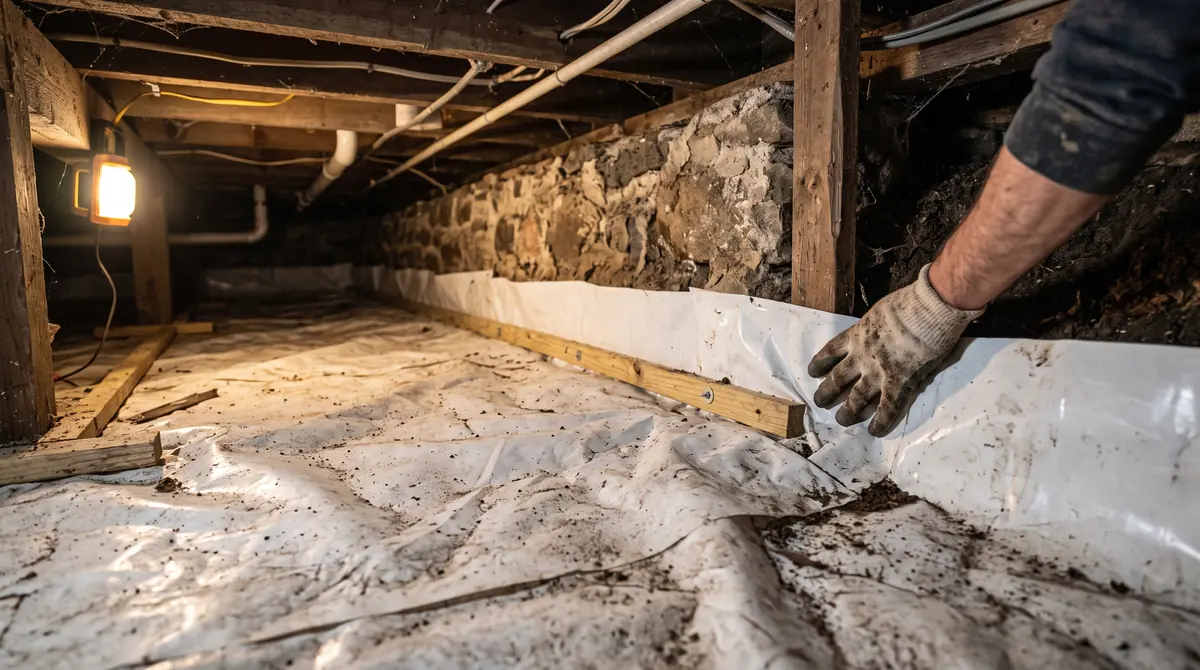
Crawl Space Encapsulation for Black Mountain Houses
In Black Mountain, rain running down a hillside lot soaks the ground against your uphill foundation wall, and the crawl space stays damp. We handle crawl space encapsulation for homeowners here, so the space under your floor stays dry and stops smelling musty.
How does water get under a house built on a slope?
It runs downhill through the soil and soaks the dirt pressed against your uphill foundation wall. From there it seeps through the block or under the footing into the crawl space. On hillside lots here, that's what's behind most of the damp crawl spaces we find. Sealing only works once we turn or drain that water, and then the space underneath stays dry.
Does the downhill side of the crawl space need work too?
The downhill side usually needs work too, though less than the uphill wall. Water that gets in at the top tends to run across the dirt and settle at the low end. We often find that side dry on the surface and wet just below it. We treat the crawl space as one space, because damp air moves through all of it, not just the wet corner.
Rain comes down the mountain and into the uphill wall
On a hillside lot, the wall that faces uphill is the one that gets wet. Rain lands above your house and runs down through the yard. The dirt along that wall holds it like a sponge. Your crawl space sits right behind that dirt, so its uphill end stays damp long after the storm's gone.
The mountains wring extra rain out of the air over Black Mountain. Air rides up the slopes, cools and drops its water on the hill above your house. From there, it all runs downhill to that uphill wall. When Helene hit, we saw the Swannanoa River, which runs from Black Mountain down to Asheville, rise to historic levels on Sept. 27. After a storm like that, the dirt above your house stays soaked for days.
We get under a lot of houses on slopes here, and the damp is nearly always worst at the uphill end:
- The dirt is wet or muddy up top while the downhill end looks dry.
- The block on the uphill wall shows dark streaks or a white, chalky crust.
- A musty smell comes up through the floor for days after a heavy rain.
- Insulation near that wall hangs loose or feels damp to the touch.
Down by the creek, flood rules change the yard work
If your lot sits low near a creek, fixing the yard may not be the easy answer. The Town of Black Mountain has rules on what you can build or do in the floodplain and floodway. Regrading, hauling in soil or cutting a new drain line down there all fall under those rules. So on a low lot, more of the fix happens under the house.
Higher up the hill, it's often the other way around. A swale or a regraded strip above the house can turn the water before it reaches your wall. Then there's far less to deal with underneath. We look at where your lot sits before we suggest either one.
Stop the water first, then close the space up
We don't seal anything until the water stops reaching the dirt. On most hillside houses here, that means waterproofing along the uphill side and, where it's already pooled, water removal at the low end. Once the ground under the house stays dry, encapsulation closes the space off and a dehumidifier keeps the damp mountain air from building back up.
At Craggy Crawlspace we size the job to what we find. One wet corner at the top of an otherwise dry crawl space is a small job. A space that holds water after every storm is a bigger one. We'll tell you which you've got.
Frequently asked questions
Should I fix the yard before you seal the crawl space?
Fix the simple things first, like a downspout that dumps water right against the uphill wall. Every bit of water you turn away from the house is water that never reaches the dirt underneath. Bigger yard work, like regrading, depends on where your lot sits. On low ground near the creek, the flood rules can push more of the fix under the house, so we look at both before you spend anything.
Will a hillside lot cost more to seal?
It can, but the slope alone isn't what moves the price. What moves it is how much water reaches the uphill wall and what it takes to stop it there. A crawl space that's tall at one end and tight at the other takes longer to work in, and that shows in the price too.
Why does my crawl space smell musty when the floor looks dry?
Damp air causes it as often as standing water does. Humid air drifts in through open vents, meets the cooler dirt and framing, and leaves moisture on the wood. On a hillside, the uphill dirt also stays wet well after the surface dries. That damp feeds the smell coming through your floor, and you'll often spot sweating ducts or dark, soft wood long before you see a puddle.
Tell us how your house handles a hard rain
Tell us which wall gets wet, how long the smell hangs around after a storm, and if you've ever seen water at the low end. All of it helps us picture your lot before we get under the house. Asking for a quote through this site costs you nothing.
Wherever your house sits on the hill, phone us or send the form, and a local technician will call you back about that uphill wall and the rest of the house.