
Crawl Space Water Removal for Asheville Homes
Crawl space water removal in Asheville means pumping out standing water, getting the framing dry and pulling out what can't be saved. It clears a flooded crawl space before the water soaks into the joists. You'll see what it costs before you commit.
What should I do first when water is standing under my house?
Turn off the breaker for anything down there sitting in water, and stay out of the crawl space. From the access door, see how high the water reached and if it's still rising. If you hear a pipe running, shut the main water valve. What you see from the door tells us if it's a leaking pipe, the yard or a creek.
Will pumping keep the water from coming back?
No, pumping clears the water that's there now and does nothing about how it got in. While we work, we watch where it enters. It might be a crack in the foundation wall, a vent at ground level or a low corner where the yard drains toward the house. Keeping it out means fixing that path, usually from outside, and sometimes adding a sump pump, which sits in a pit at the lowest spot inside.
When is a wet crawl space really dry?
It's dry when the wood reads dry on a moisture meter, not when the dirt looks dry. Pumping out the standing water is the quick part. The joists and the boards above them hold water much longer. We take readings on the first day and keep the fans and dehumidifiers running until they come down.
Where the water sits and what it soaks
Water under a house runs to the low spots and stays put. It pools in the corners, along the foundation wall and in the dip by the access door. The piers, the brick or block columns that hold up the middle of the floor, often stand right in it. A puddle gets no sun and little air down there, so it can sit long after the yard has dried.
And it doesn't stay down on the dirt.
- The ground cover. Water slips under the plastic laid over the dirt and stays trapped there.
- The insulation. Batts between the floor joists, the beams under your floor, soak it up and sag.
- The framing. The joists and the sill plate, the board where the framing meets the masonry, can go soft.
- The ducts. Ductwork lying on the dirt can fill with water.
- The rooms above. Damp air rises through the floor, and you smell it in the house.
The longer it sits, the more wood and insulation we end up pulling out.
How we pump it out
We pump it from the lowest spot, but the work starts at the access door. First we find anything electrical sitting in the water and make sure its power is off. Then we suit up in boots, gloves and a mask, since that water has run through dirt and whatever else is down there.
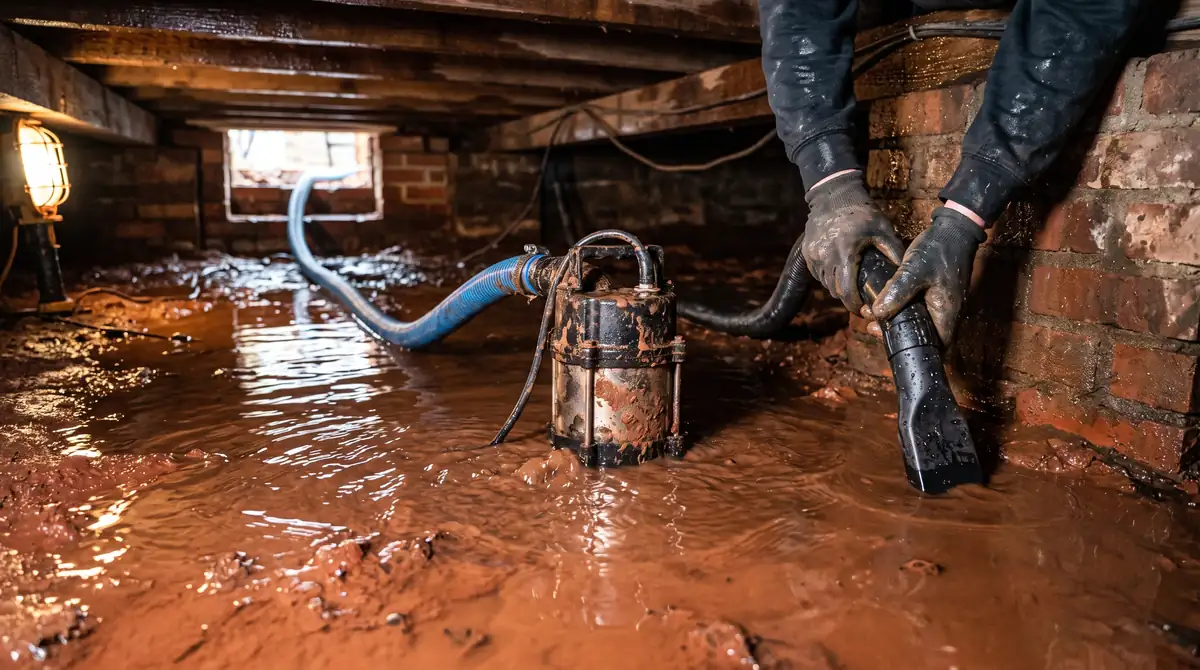
We set a submersible pump, one built to run under water, in the deepest spot. The water leaves through the discharge line, a hose we run out the access door. We lay its far end well away from the foundation so the water can't drain back underneath. Where it's too shallow for the pump, we finish with a wet vacuum.
While the pump runs, we check the supply and drain pipes under the floor. A dripping supply line can fill a low corner with no rain at all. If we find a leak, we'll show you where it is.
Getting the wood dry, not just the dirt
The puddles go first, but the wood holds water much longer. We open the foundation vents and clear out the leaves and debris. Then we set fans to pull the damp air out of the crawl space, and dehumidifiers to dry what's left of it.
We measure the drying with a wood moisture meter. It's a handheld tool that reads how wet the boards are. We take readings on the joists, the sill plate and the subfloor, the boards under your flooring. The fans stay on until those numbers drop, and we put nothing new back until the framing reads dry.
If the air stays damp long after the water's gone, a dehumidifier that stays under the house can keep pulling it out after we've packed up.
Pulling out what can't be saved
Insulation that's been soaked rarely comes back. Wet batts hang heavy, hold water against the subfloor and sag onto the dirt. We pull them, bag them and carry them out through the access door. Torn or muddy ground cover goes out the same way.
With the batts down, we can finally see the wood. Dark stains on the joists mean the framing stayed wet too long. So does a spot that gives when we push a screwdriver in. We'll point out each one.
New insulation under the floor is a separate job we take on once the wood reads dry. Where a joist or the sill plate has gone soft, we'd shore up the framing first.
After the crawl space has flooded
Flood water makes a bigger job than a leak. It comes in fast and climbs up into the ducts and the insulation. When it drops, it leaves mud and silt on the dirt.
If your house sits near a creek, the water under it can rise and fall with the stream. So we wait for it to stop coming in before we pump. If we didn't, the creek would just fill the space back up.
After a flood, we shovel out the mud and bag it with the wet insulation before any drying starts. Fans can't dry wood that's still caked in it. Keeping the next storm out is a different job: waterproofing the crawl space goes after where the water gets in, mostly from outside.
We pump out flooded crawl spaces in Hendersonville, Candler, Swannanoa, Weaverville, Fletcher, Mills River, Black Mountain and Mountain Home too.
What moves the cost of pumping and drying
The price turns on the water, the access and the drying. When we look under your house, we'll go over which of these apply.
- How much water. One wet corner pumps out fast, and a whole floor of it takes longer.
- How hard it is to reach. A low crawl space or a small access door slows every step.
- How far the hose runs. On flat ground, the discharge line may need a long run to clear the foundation.
- How long it takes to dry. Soaked framing keeps the fans running longer than damp dirt.
- What comes out. More wet batts, torn plastic or mud means more to haul off.
The quote costs you nothing, and you'll know the price before you say yes to any of it.
Frequently asked questions
How much does it cost to remove water from a crawl space?
The kind of water moves the price most. Clean water from a burst supply line usually means a pump-out and drying. Storm or creek water leaves mud and silt in the insulation and on the dirt, and all of that comes out by hand. If water's still coming in, that can mean a second trip.
What takes moisture out of a crawl space?
Moving air and dehumidifiers take it out once the standing water is gone. Fans push wet air out through the vents, and a dehumidifier pulls water from the air that stays. The bigger source over time is the bare dirt, which gives off damp after every rain. Covering that dirt and closing up the space keeps it drier between storms.
What has to happen first, and what can wait?
Getting the water out and the wood dry comes first, and the rest can wait. We pull the wet batts and muddy plastic at the same time, since they hold damp against the wood. We check the wood with a meter, because it can look dry well before it really is. You can decide on new batts or a new ground cover once the framing's dry.
Still have water under the house?
Tell us how high the water got. Did it show up with a storm, or on a dry day? Water on a dry day points to a pipe, and water after a storm points to the yard or a creek. Craggy Crawlspace works under houses all over the area, and pumping out water is often where we start.
Send the form or give us a call, and one of our technicians nearby will call you back to talk over the house and the water under it.