
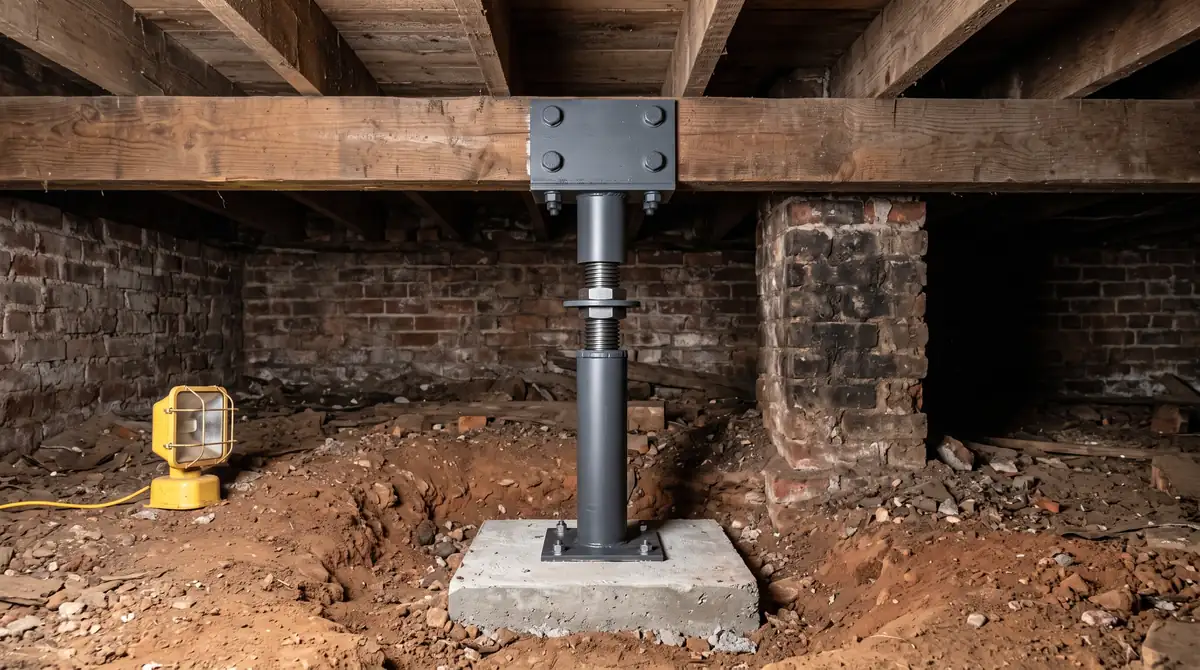
Crawl Space Repair in Asheville
We do crawl space repair in Asheville: we sister weak joists, put support back under the girder and swap out soft wood. It's how a floor that bounces, sags or slopes underfoot gets solid again. The free quote shows the cost before you commit.
How do you fix a sagging floor from underneath?
We put support back under the part that dropped, then raise the floor slowly. Under a sagging girder, we set a screw jack on a sound footing. Each turn lifts the beam a little, so the walls and door frames above can catch up. For a weak joist, we sister a new board alongside it. Most of these jobs end with the posts on footings and the floor level and solid again.
Why does my floor dip in the middle?
A dip in the middle usually means the girder or the posts under it have settled. A post can sink into soft dirt, crack its footing or go missing. Then the girder sags between the posts that still hold, and the floor above follows it down. Nearby doors often start to stick about then.
What the floor above is telling you
You'll usually spot a framing problem from the living room, not the crawl space. The floor gives when you cross it. A dropped marble rolls toward one wall.
- A bounce underfoot in one room usually means a joist has cracked or gone soft.
- A dip down the middle tends to come from the girder or the posts under it.
- A slope toward an outside wall often starts at the sill plate.
- Doors that stick or won't latch tell you the frame around them has shifted.
- Cracks running up from the corners of doors and windows show the same movement.
A dip and a sticking door in the same room usually come from a post that's sunk under them.
What holds the floor up, and how it gives way
The weight of a floor travels down through a short chain of parts. The joists are the long boards set on edge that the subfloor is nailed to. Most rest on a girder, the heavy beam down the middle of the house. It's often several boards bolted together.
Posts hold the girder up. Each one should stand on a footing, a concrete pad set in the dirt. Around the edge, the joists sit on the sill plate, also called the mud sill. That's the board laid flat on top of the foundation wall.
The sill is the wood closest to the damp. When it stays wet, it softens and crushes, and that side of the floor drops.
In the middle, the trouble is usually a post. One set on bare dirt or a cracked pad sinks over the years. Sometimes a post is missing, or it's propped on scrap wood that has split. Joists fail too, when one's been notched for a pipe or sat damp too long.
How we put support back under it
We start by finding what failed, not just the spot that bounces. We crawl the whole space with a flashlight and a wood moisture meter. That's a handheld tool that reads how much water is in the framing.
We check the drain and supply lines for leaks too. One dripping pipe can soak a joist while the rest stay dry.
- Sistering a joist means bolting a new, full-length board tight against the weak one. The two carry the floor together.
- Where a post sank or went missing, we pour a concrete footing in the dirt. Then we stand a new post on it.
- Under a sagging girder, we set a screw jack. It's an adjustable steel post with a threaded section we turn to raise the beam. We bring it up a little at a time so the walls above can follow. We use posts coated in rust-inhibitive paint, since bare steel rusts in the damp.
- Where the sill plate has gone soft, we hold the floor on temporary supports, cut out the bad section and slide a new board onto the wall.
Sistering won't help a sunken post, and a jack won't help a crushed sill. So we find the failed part first and match the repair to it.
We shore up floors outside the city too, in Hendersonville, Candler, Swannanoa, Weaverville, Fletcher, Mills River, Black Mountain and Mountain Home.
When the framing has been sitting wet
Wet framing is behind most of the repairs we make. A joist that stays damp for years loses its strength, and new wood set into the same damp heads the same way. So in a wet crawl space, we fix the framing and tell you where the water's coming from.
The wood has to be dry before we rebuild. If water's standing on the dirt, getting the water out and the wood dry comes first. We check the old framing with the moisture meter before new wood touches it.
If high water has ever reached your crawl space, we check the sill plate and the posts first, since they sit closest to it.
Water that keeps coming back after hard rain is a drainage problem. Waterproofing outside and along the footing deals with that. Damp air rising off bare dirt is different, and sealing the crawl space in is how we handle it.
What moves the cost of fixing it
The price follows how much framing has failed and how hard it is to reach. One sistered joist near the access door is a small job. A soft sill plate along a whole wall is a big one, because we hold the house up while we swap the wood under it.
Room to work matters as much as the repair. A crawl space we can kneel in goes faster than one where we're lying flat under the ductwork. New footings dug for a girder cost more than a jack set on a sound pad.
Wet wood adds a step too, since we dry it before we rebuild. If the access hatch cover has warped, we can swap it while we're down there.
What goes into the estimate
The framing repair sets the price, plus any drying the wood needs first. We work it out once we've been under the house. If something beyond the framing is keeping the wood wet, we'll tell you, and you can decide on that fix later. The estimate costs you nothing to ask for.
Frequently asked questions
How much does crawl space repair cost?
How far the damage goes moves the price most, and the floor upstairs doesn't show it. A dip in the hallway might be one sunken post, or a girder that's settled along its whole length. If the wood went soft because the dirt stays wet, fixing the water is a separate job, and we'll walk you through both.
Can you just fill a crawl space with concrete?
It won't fix a sagging floor. Concrete poured over the dirt just sits on the ground. It never reaches up to hold the joists or the girder, so the weight still comes down through posts on footings. Filling the space also buries the pipes and wiring you'll need to reach later, and it leaves us no room to work.
How do I dry out my crawl space after a flood?
Get the standing water out first, then move air through the space. Open the access door, and the vents if the weather's dry, and point fans through. Leave the plastic and insulation out until the joists and sill plate read dry on a wood moisture meter. Check the pipes under the floor too, since a slow leak keeps the dirt wet long after the flood.
Tell us what the floor is doing
Walk the floor before you call. Note where it bounces, dips or slopes, and which doors stick. That's enough for us at Craggy Crawlspace to know where to start under the house.
Describe the bounce or the dip by phone or through the form, and a technician from around here calls you back to go over your house.