
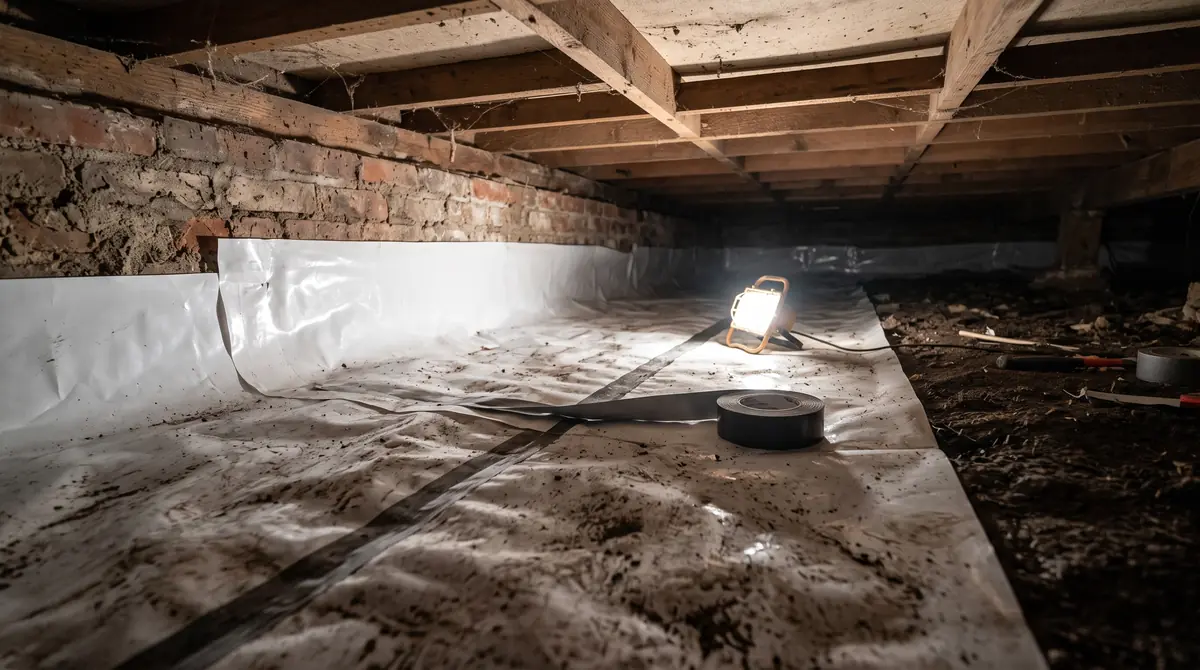
Crawl Space Encapsulation in Mountain Home
Mountain Home yards can shed a hard storm's rain straight under the house, and it doesn't leave on its own. We get standing water out for homeowners here, then handle crawl space encapsulation so the space under the floor stays dry.
Why does water get under my floor in a heavy storm?
Water finds its way under the floor because on many lots the crawl space sits below the yard around the house. In a heavy storm, rain falls faster than the yard can soak it up. It runs toward the foundation and gets in at the vents, the block joints and the base of the walls. Downspouts that empty right at the wall send even more to the same spot.
What should I do first when a storm puts water under the floor?
Shut off the power to the crawl space before anyone goes under the floor. Then we get the standing water out and give the joists and subfloor time to dry. We don't seal anything until the crawl space has dried out, so it stays dry and the floor above stays sound.
Rain faster than the yard can take it
Helene put at least 11.6 inches of rain on Mountain Home, and no yard can soak up that much. What the ground can't take runs across the surface to the lowest spot it can find. On most houses, that's the dirt under the floor.
Flash floods have hit here in other storms too, and the weather service has put Mountain Home under flash flood warnings before. In storms like those, water runs across the ground faster than the ditches and creeks can carry it away. It piles up against the foundation and pours in through the crawl space vents and any crack in the wall.
If the water's still standing down there
Keep out from under the house until the power to everything down there is off, because standing water and live wiring are a bad pair. Most crawl spaces hold more wiring than people expect: outlets, a pump, the furnace. Shut those circuits off at the panel first.
You don't have to bail anything yourself, and a shop vac and a bucket won't keep up with that much storm water anyway. Every trip in means kneeling in it. The sooner it's out, the less the wood above soaks up.
What sitting water does to the floor above
Standing water doesn't stay a puddle for long. As it dries off the dirt, it loads the air under the house with moisture. The joists and subfloor soak that up. You'll usually notice it upstairs before anyone sees it below:
- A musty smell coming up through the floor registers, worse on warm days.
- Floors that feel soft or springy, or start to dip near the middle of a room.
- Insulation batts that soaked through and dropped onto the dirt.
- Mold on the joists or the underside of the subfloor, and wood that's turned dark and soft.
Mold is a sign the crawl space has stayed wet. That's work for a mold company, not us; we stick to the water and the damp that keep it going.
Getting the water out, then keeping it out
The water has to come out and the framing has to dry before we seal anything under the house. We start with water removal for what's standing now and a clean-out of the soaked insulation, torn plastic and mud the storm left behind.
Where the joists stayed wet long enough to go soft, we do the repair work, then we go after the spots where the water got in with waterproofing. That gives the next big rain a harder time reaching the dirt under your floor.
Frequently asked questions
Should I call while there's still water under the house?
Yes, call while it's still there. Seeing the water in place shows us where it came in and how high it rose. That tells us more than a dry floor will later. Waiting for it to drain away only gives the insulation and the joists longer to soak it up. That's what turns a wet crawl space into a repair job.
What adds to the cost after a storm?
How much water got in and how long it sat there move the price most. A crawl space that held water for days usually has soaked insulation to haul out. The wood needs drying, and sometimes repair. Low, tight crawl spaces take longer to work in. If the water came from outside, like a downspout dumping at the wall, fixing that adds to the job too.
Will the water under my house dry out on its own?
Some of it will sink into the dirt, but the crawl space stays wet long after your yard looks dry. There's no sun down there and little moving air. The moisture hangs around and settles into the joists and subfloor. That slow drying is when the musty smell starts and the batts begin to sag. Getting the water out fast keeps the damage smaller.
Is the storm water still under your floor?
Let Craggy Crawlspace know how high the water got and how long it's been sitting there. There's no charge for a quote through this site.
When the rain lets up, call or send the form, and a local technician phones you back about your house and how high the water got.