
Crawl Space Vapor Barrier in Asheville
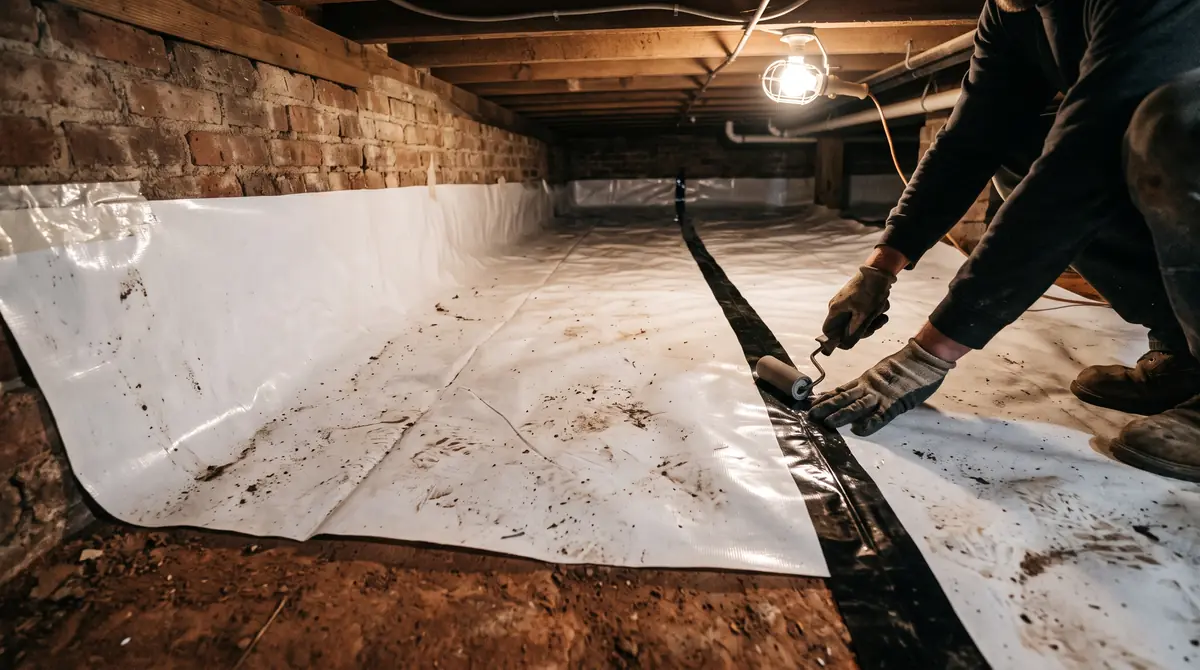
Our crawl space vapor barrier in Asheville is heavy plastic over the bare dirt, taped at the seams and run up the walls. It stops ground moisture that makes the rooms above smell musty, so they stay drier. You see the price before you commit.
What's the first step with new plastic under the house?
We start by looking at what's on the dirt right now. We check the old plastic for rips, loose edges and standing water. Then we look at the ground for rocks, roots and low spots. That tells us whether we pull the old sheet or lay over it, and how much prep the floor needs before we roll anything out.
Is a vapor barrier the same as encapsulation?
No, a vapor barrier covers the ground, while encapsulation seals the whole crawl space. We lay the plastic over the bare dirt and carry it up the walls and piers. That keeps moisture in the soil from rising into the house. Encapsulation goes further: we also close the vents and seal the walls, leaving the space drier still.
What happens to the old plastic?
Torn or muddy plastic leaves with us, but a sheet that's whole and fairly clean can stay. We bag the old sheet, along with any debris on it, and carry it out through the access door. When the old sheet stays, we roll the new plastic right over it and tape every seam. Either way, you won't find loose scraps of plastic under the floor when we're done.
What comes up through bare dirt
Moisture comes up through bare dirt all year, even when the ground looks dry. The soil under your house holds water, and it rises into the crawl space as vapor. That damp settles on the floor joists, the subfloor and the ductwork. A musty smell in a back bedroom is often the first thing you notice.
A vapor barrier puts plastic between that soil and the house. Crews call that sheet the ground cover. We use heavy polyethylene and lay it over every bit of exposed dirt. The vapor stops at the plastic instead of soaking into the wood.
Soil gases like radon come up the same way. The U.S. Environmental Protection Agency designates Buncombe County as a Zone 1 county, so the average home will test over 4 picocuries per liter of radon. A ground cover sealed at its seams and edges slows that gas along with the damp. Only a radon test tells you where your own house stands.
Replacing old plastic that's torn or pulled loose
Old plastic needs replacing once it stops covering the dirt. Crawl in with a flashlight and look for three things. Dirt shows through rips, sheets have slid apart at the overlaps, or the edges have dropped off the foundation walls. Water sitting on top of the plastic, or mold spots on the joists overhead, means damp is still getting through.
If the old sheet is shredded or muddy, we pull it up, bag it and haul it out through the access door. If fallen insulation and junk are down there too, a full clean-out of the crawl space comes first. A sheet that's whole but worn can stay, and we lay a new layer over it, sealed at every seam.
Can torn plastic be repaired?
Yes, when the damage is a handful of tears in an otherwise sound sheet. We tape small tears and re-tape seams that have opened. For a bigger rip we use what installers call target-and-cover: a tight patch stuck over the tear, then a larger one reaching past it. Once tears run across most of the floor, new plastic makes more sense than patches.
How we lay a new ground cover
We work from the far corner back toward the access door, so nobody crawls across finished plastic. Every crawl space vapor barrier installation at Craggy Crawlspace follows these steps.
- We rake the dirt smooth and pick out sharp rocks, roots and old nails. Where water collects, we grade the floor so it drains to a low spot.
- We roll the polyethylene out in wide sheets, starting at the back wall.
- Where two sheets meet, we overlap them and tape the seam. Then we run a roller over the tape so no air pockets hide under it.
- We carry the plastic up the foundation walls and hold it with strapping. That's a strip pinned or screwed to the wall that keeps the edge flat.
- We wrap every pier, the block or brick column holding up the floor. Then we fasten the plastic to it and seal the edge.
- Before we leave, we check the whole floor for gaps at the walls and around pipes.
The edges are where a rushed job fails. Plastic that stops at the dirt line leaves a gap, and damp air slips right around it. Under a mobile home we do the same work inside the skirting and cover all the dirt beneath it.
Is thicker plastic worth it?
Thicker plastic earns its keep when people will be moving around on it. A heavier ground cover shrugs off knees, dropped tools and the odd sharp rock. Years from now, when a plumber crawls across it, it's still in one piece. Boxes you store down there won't hurt it either.
Thin sheeting rips the first time a toolbox gets dragged across it. Once it's torn, the damp comes straight back through. Heavier rolls are stiffer to fold around piers and slower to fit, and that shows on the quote. Weigh the extra cost against how your crawl space really gets used.
Where plastic on the ground stops short
A ground cover deals with what rises from the dirt, and that's all. It does nothing about muggy summer air pulled in through the foundation vents. Closing the vents and sealing the walls too is crawl space encapsulation. Ask about it if humid air is your bigger problem.
Plastic can't stop water that runs in after storms, either. If puddles form on the dirt after heavy rain, we fix the water getting in from outside first. We lay ground covers under houses in Hendersonville, Candler, Swannanoa, Weaverville, Fletcher, Mills River, Black Mountain and Mountain Home too.
What moves the cost of laying new plastic
The size of the crawl space and how hard it is to work in set most of the cost. We look at six things, and you'll see which apply to your house.
- How much there is to cover. That's the dirt floor, plus every wall and pier the plastic runs up.
- How much room we have. A low crawl space where we're on our bellies takes longer than one we can kneel in.
- What has to come out first. We bag old plastic and debris and haul it out before laying anything new.
- What hangs in the way. Low ductwork, pipes and wiring mean more cuts in the plastic and more edges to seal.
- The ground itself. Rocks, roots and low spots that need grading add prep time.
- How heavy a plastic you choose. Thicker rolls cost more and take longer to fit.
You'll know what the work comes to, and why, before you agree to anything.
Frequently asked questions
How much does it cost to add a vapor barrier to a crawl space?
How the edges are finished moves the price most. Plastic staked down at the edge of the dirt goes in quicker. If we run it up the walls and seal it, that takes more material and hours, but it keeps damp from slipping in around the sides. Pulling up an old sheet and getting the dirt ready add to the cost too.
Do you really need a vapor barrier in a crawl space?
If the floor down there is bare dirt, yes. Soil gives off moisture in every season. With nothing over it, that damp works into the joists and the subfloor and drifts into the rooms upstairs. A plastic ground cover belongs over the dirt in a vented crawl space and a sealed one alike. Without it, every other fix under the house is fighting the ground.
What should I use as a vapor barrier in a crawl space?
Use polyethylene sheeting, the heavy plastic that comes in wide rolls. That's what the trade lays as a ground cover. It works when the seams are overlapped and sealed with tape or a bead of butyl caulk. Skip tarps and painter's plastic, which tear the first time someone crawls over them. If anyone will be crawling around down there for repairs later, go heavier.
What size vapor barrier does a crawl space need?
Most crawl space liners run 10 to 20 mil thick. You need enough to cover every bit of dirt, climb the foundation walls and wrap each pier, with extra at every overlap. That adds up to more plastic than the floor area of the house. Ten mil is the usual choice, and heavier grades hold up better where people crawl around a lot.
Want the dirt under your house covered?
Tell us what you've spotted down there, like torn plastic, bare dirt or a musty smell upstairs. It costs nothing to ask us for a quote.
Send the form or call, and a local technician will phone you back to talk about your house.