
Crawl Space Insulation for Asheville Homes
Crawl space insulation in Asheville means pulling out sagging or soaked batts and fitting new ones, or putting foam on the walls of a sealed space. It fixes a cold floor and keeps the rooms above warmer. You'll know the cost before you commit.
Where do I start if my floors are cold?
Start at the crawl space access door with a flashlight and look at the insulation under the floor. If the batts hang in loops, feel damp or lie on the dirt, that's where your heat is going. Most of the old batts we pull out have sagged away from the subfloor. When we fit new batts tight and hold them up with supports, you get warmer floors.
Why do the batts keep falling down?
Batts fall because damp makes them heavy and the staples holding them give out. The water comes from humid air and from the bare ground under the house. New batts held with metal staves stay up much longer. If the crawl space stays damp, though, they'll sag too, so we check how wet the space gets before we hang any.
If you insulate the walls, do the floor batts come out?
In a sealed crawl space, we usually take the floor batts out once we've insulated the walls. The warm side of the house moves down to the foundation walls and rim joist. Batts between the joists stop doing any work there, and old fiberglass can hold damp against the subfloor. We'll go over what we'd remove with you first.
Why the floor over the crawl space feels cold
A winter floor loses its heat down through the subfloor, the plywood deck your flooring sits on. Under it, the floor joists run side by side. The bays between them should hold insulation that touches the subfloor all the way across. When it pulls away, cold air fills the gap and your floor gives its warmth to the dirt below.
Most houses we crawl under have fiberglass batts, precut strips of insulation pressed up between the joists. They don't last in a damp crawl space. Fiberglass takes on moisture from humid summer air and bare ground, then gets heavy and sags. Wet insulation barely slows heat, and once the staples let go, the batts drop.
Shine a flashlight through the access door and you may see:
- Batts hanging in loops between the joists, or lying on the ground.
- Insulation that's dark, matted or damp to the touch.
- Bare subfloor where a batt slipped out.
- Mold spots on the joists or the paper facing, a sign the space stays damp.
- Droppings or nesting tucked into the batts.
Any one of those means heat is leaking through the floor. It usually means the crawl space holds too much moisture, too.
Insulate the floor or the foundation walls?
That depends on whether your crawl space is vented or sealed. A vented one has openings in the foundation walls that let outside air through. In winter it's nearly as cold down there as the yard. So the insulation belongs between the floor joists, snug against the subfloor.
A sealed crawl space is the opposite. Once we've closed the vents, covered the ground and lined the walls, the space stays close to the temperature of your rooms. Then we insulate the foundation walls and the rim joist instead, and the floor needs no batts.
If you're weighing sealing off the crawl space down the road, tell us before we hang new batts. That way you won't pay for batts we'd pull out later.
When spray foam is the better fit
Spray foam earns its keep where a batt can't seal: the rim joist, and the gaps around pipes and wires. The rim joist is the board that runs around the outer edge of the floor framing. It rests on the sill plate, the wood laid flat on top of the foundation wall. Outside air leaks in along both.
We use closed-cell spray foam there, a foam that sets hard and doesn't soak up water. It seals and insulates the rim joist in one pass. Before we spray, we check the sill plate and rim for soft or wet wood, because foam over damp framing only hides it.
In a sealed crawl space, we can spray the foundation walls too. In a vented one, we keep foam to the rim joist and the gaps and fit batts between the joists.
Foam board on the walls instead
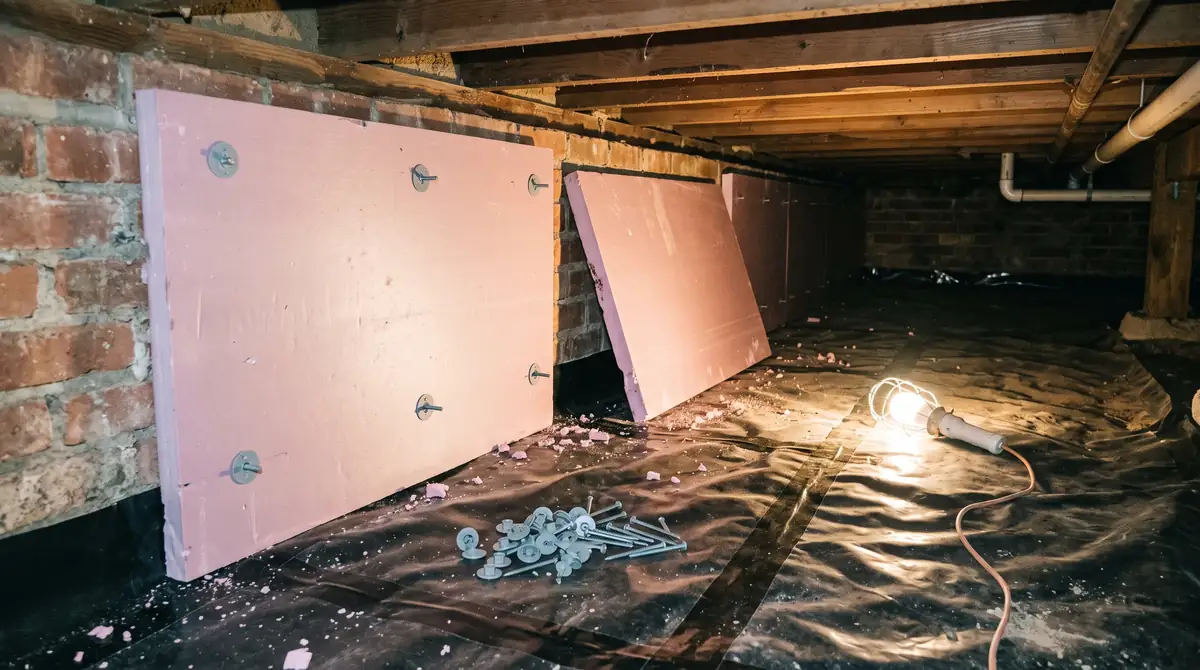
Rigid foam board is our usual choice for the walls of a sealed crawl space. It comes in stiff sheets of polyisocyanurate or extruded polystyrene (XPS), and both shrug off damp. We set unfaced sheets against the inside of the foundation walls and fix them with masonry fasteners. Wide button cap washers under the fasteners hold the foam without crushing it.
Air slips past at the seams and edges, so we seal them with canned spray foam and caulk. We cover the closed vents with foam and glue a piece to the back of the access door, so the door isn't the one cold panel left. Under all of it, a sealed ground cover over the dirt keeps soil moisture out.
Replacing batts that have sagged or soaked through
When batts are wet, moldy or down on the dirt, we take them out and put in new ones. Fiberglass that has held water rarely dries back to what it was. We work from the access door inward:
- We pull the old batts down, bag them in the crawl space and carry the bags out the access door.
- With the bays open, we check the subfloor, joists, rim joist and sill plate for damp or soft wood.
- We fit new precut batts sized by R-value and press them tight to the subfloor, with no gaps, folds or crushed spots.
- We hold each batt up with metal staves or wire, thin supports that spring between the joists.
- Last, we spray foam along the rim joist and close the gaps around pipes.
If the space is full of torn plastic and junk, we'll do a full clean-out under the house first.
When a repair is enough
A few batts slipping in one corner don't mean the whole floor needs new insulation. If they're dry and clean, we lift them back against the subfloor and add supports. We'll show you any soft wood we find while we're under there, since fixing the framing under your floor is a separate job.
We pull and replace insulation under houses in Candler, Weaverville, Swannanoa, Black Mountain, Fletcher, Mills River, Mountain Home and Hendersonville as well.
What moves the cost of new insulation
The size of the floor and what's already under it move the price most. Stripping out wet, matted batts takes longer than insulating open joists.
A low crawl space with one small access door means more time on our knees for every bag in and out. What we put in counts as well, since batts between joists, foam at the rim joist and foam board on the walls take different work and materials.
What the estimate comes down to
That's the area we'd insulate, what we'd pull out and what we'd put back in. If we find soft wood once the bays are open, you can decide about that repair later. Asking us for a quote costs you nothing.
Frequently asked questions
How much does crawl space insulation cost?
How big the floor is and how much old insulation has to come out first move the price most. Batts between the joists of a vented crawl space aren't the same work as foam board on the walls of a sealed one. If you're comparing quotes, make sure they cover the same job.
How much does it cost to remove insulation from a crawl space?
How wet the old insulation is moves the price most. Dry batts come down quickly. Wet, matted fiberglass is heavy and tears apart in your hands, so we bag it in the crawl space before carrying it out. A big floor adds time, and so does insulation mixed with debris on the dirt. New insulation is priced on its own.
Can you insulate a crawl space?
Yes, and where it goes depends on how the space is built. In a vented crawl space we insulate between the floor joists and hold the batts up with metal staves. In a sealed one we insulate the foundation walls and rim joist. In both, we check the moisture first, since insulation won't stay put in a space that keeps getting damp.
What insulation is needed for a crawl space?
The common recommendation for our climate is R-10 to R-13 on the walls of a sealed crawl space and R-19 under the floor of a vented one. Foam handles a damp crawl space better than fiberglass, because it doesn't soak up water. Rigid board on the walls and closed-cell spray foam at the rim joist are the usual picks. Fiberglass batts still work under a vented floor, as long as they're held up tight and the space stays dry.
Is it worth it to insulate a crawl space?
If the floors over it are cold every winter, it usually is. When the insulation has sagged or fallen, the heat you pay for leaks through the subfloor into the dirt. Putting it back tight makes the rooms above more comfortable. When the batts are dry and still in place, the cold may come from somewhere else, like air leaking at the rim joist.
Floors cold again this winter?
Tell Craggy Crawlspace what you've noticed, like a room that stays cold all winter, batts hanging down or a damp smell at the access door. Then ask for a free quote, and you'll see what the work costs before anything starts.
Send the form or call, and a technician from nearby will ring you back to talk about your house and the floor over your crawl space.