
Crawl Space Waterproofing for Asheville Houses
Crawl space waterproofing in Asheville covers the gutters, downspouts and grading outside, then a drain and sump pump under the house. It stops water from pooling on the dirt after a storm and keeps the space dry. You get a free quote first.
Where do I start if water keeps getting under my house?
Start outside, with the gutters, the downspouts and the way the yard slopes. That's where we look first, before we crawl underneath. Water you stop at the roof and in the yard never reaches the dirt under the house. If some still gets in, we lay a drain along the footing and set a sump pump in the low spot to keep the crawl space dry.
Does waterproofing mean digging up the yard?
It means narrow trenches where the water needs a path, not a torn-up yard. A buried downspout line or a French drain takes one trench, and we bed perforated pipe in gravel there and lay the sod back on top. We only dig deep, down to the footing, when the walls sit below the ground outside. We put a waterproof membrane on the outer face of those walls before we fill back in.
Where the water under your house comes from
Most of it starts outside. In a vented crawl space, the wet dirt is usually from runoff, not damp air.
- An overflowing gutter dumps the roof's rain down the face of the foundation.
- A downspout that empties at the wall soaks the dirt right down to the footing.
- A yard that slopes toward the house sends runoff straight at the vents and the block.
- Ground that stays soaked pushes water up through the dirt floor into the low spots.
You can tell which by what it leaves behind. A tide line on the piers or mud fanned across the dirt means runoff got in. If the floor's wet all over, the water's coming up from below. A lot of houses have two going at once.
Stopping it at the roof and the yard
We start outside. Water that never reaches the foundation never has to be pumped, and on some houses that's all it takes.
We clear the gutters first and rehang any that spill over. We tie each downspout into a buried pipe and run it out into the yard. It comes out at daylight, which just means open ground lower on the slope, or at a yard bubbler.
A bubbler is a small cap in the lawn that pops up and lets the water out away from the house.
Where the dirt outside slopes toward the house, we regrade it so it falls away. Where there's no room for that, against a bank or a patio, we dig a French drain instead. That's a trench bedded in gravel with perforated pipe running through it. The pipe has holes along its length to take the water in, and we lay the sod back over the top.
Craggy Crawlspace follows that order on hillside and low lots around Asheville and in Hendersonville, Candler, Swannanoa, Weaverville, Fletcher, Mills River, Black Mountain and Mountain Home.
The drain and pump under the house
If water still gets in, we catch it at the footing and pump it out. The footing is the wide concrete base the walls stand on. That's where seeping water collects first.
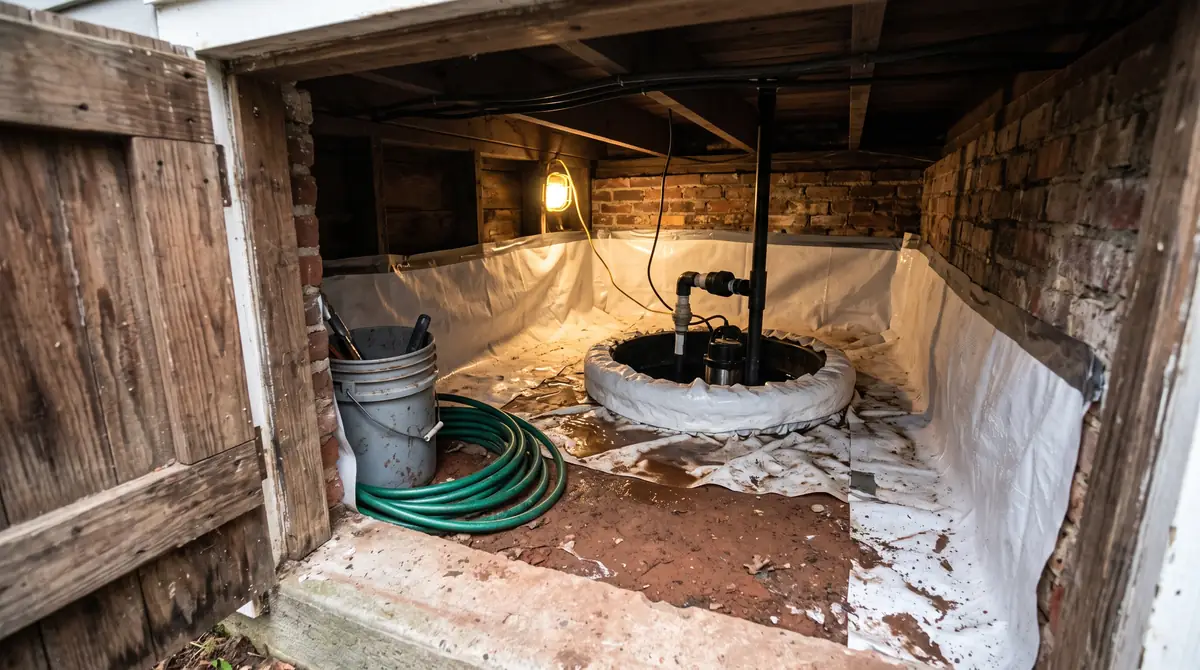
We dig a shallow trench along the inside of the footing, bed perforated pipe in gravel and slope it to the lowest corner. We grade the dirt floor toward that same corner and set the sump pump there.
The pump sits in a crock, a plastic pit with holes drilled in the bottom so water seeps in. We fit it with a lid that seals tight. An open pit just breathes damp air back under the floor.
Where the pumped water ends up
From the pump, the water runs out through the wall in a pipe we call the discharge line. That line empties at daylight, a French drain or a bubbler. We keep it apart from the gutter pipes and any outside footing drain, so a storm that fills one can't back up into the other.
When the pump shuts off, the water still in that line wants to run back into the pit. We stop that with a check valve, which makes the line one-way. On a low lot where the ground stays wet, we add a battery backup so the pump keeps running when a storm knocks the power out.
If water's sitting on the dirt right now, we'll pump it out and dry the framing before we start on the drain. Once the crawl space stays dry through a run of storms, sealing it in keeps the damp air out too.
What if the walls sit lower than the yard?
We waterproof those walls from the outside. With the yard higher than the dirt floor inside, wet ground presses on the block and water comes through the block itself, not over the top.
We dig along the wall down to the footing and coat or wrap the block in a waterproof membrane, a skin water can't get through. We hang a drainage mat over that. It's a dimpled plastic sheet that lets water run down to the footing instead of sitting against the wall.
A footing drain along the base carries that water off to daylight or a French drain, and we backfill and put the yard back. It's the biggest dig we do for water, so we save it for lots where the yard work and the inside drain can't keep up.
What the cost depends on
It comes down to how much work the yard needs, how much happens under the house, and where the water can go. We walk the yard and crawl in before we price any of it.
- Each downspout that needs a buried line adds trenching, more so on a long run.
- Regrading an open yard is a different job from trenching beside a driveway or a steep bank.
- A drain along one wet wall takes less pipe and digging than one around the whole footing.
- A low crawl space or a tight access door slows every step under the house.
- A flat or low lot needs a sump pump, where a sloping one drains by gravity.
- Walls below the yard mean digging out and wrapping the foundation, the biggest single piece.
You can set the yard work against the drain inside and pick what to do first.
Frequently asked questions
How much does waterproofing a crawl space cost?
A long trench, a sump pump or walls that need digging out push the price up most. The outside work can shrink the job inside. You can have us do the gutters, downspouts and grading first. Then watch the crawl space through a few hard rains before you decide on a drain or a pump.
Should you waterproof your crawl space?
Yes, if water's getting in. Puddles after rain, wet soil along a wall or a water stain partway up the piers all mean runoff is reaching the dirt. Left alone, it keeps the framing wet and soaks the insulation until it sags. If the dirt stays dry and all you notice is a musty smell, the trouble is damp air, and sealing the space matters more than draining it.
How do I know which fix my crawl space needs?
Keep track of how long the dirt stays wet after it rains. If it soaks in during a hard rain and dries out after, a downspout or the slope outside is usually to blame, and the fix starts in the yard. If the dirt stays damp for weeks in a wet season, even between storms, the ground under the house is holding water. It takes a drain along the footing and a sump pump to handle that.
How do you seal up a crawl space?
Get the water under control first, then close the space in. Plastic laid over a floor that still floods just holds the water under it. Once the dirt stays dry through a few storms, we clear out the old plastic and debris, then seal the vents and gaps. Then we lay a ground cover over the dirt and up the walls and piers and tape every seam. Last, we dry the air with a dehumidifier and check that it holds.
Look under the house after the next hard rain
The day after a heavy rain is when the crawl space shows you where the water gets in. Open the access door and shine a light in. Check along the walls, around the piers and at the corners under the downspouts. Look at how far the damp spreads from each wet spot, because that tells us where to start.
Tell us what you saw, by phone or through the form, and a local technician will call you back to talk about your house. Asking for a quote is free.