
Crawl Space Cleaning in Asheville
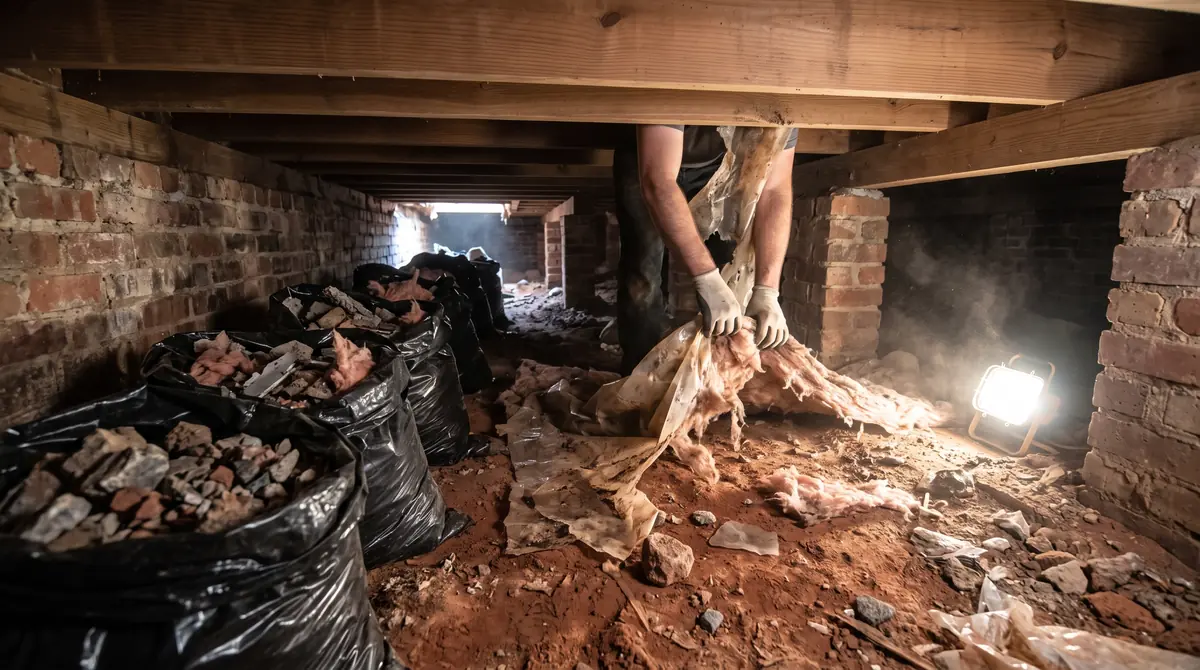
Our crawl space cleaning in Asheville hauls out torn plastic, fallen insulation and junk, down to bare dirt. It clears the mess behind a musty smell and leaves the ground ready for new work. The quote's free, so you'll know the cost first.
How do I get my crawl space cleaned out?
Start with a look through the access door so you can tell us what's down there. Note torn or missing plastic, insulation hanging from the floor or lying on the dirt, and any junk or droppings. We bag the debris, vacuum up loose fill and carry everything out. What's left is bare dirt you can see clearly.
What do you check before a clean-out starts?
We check the access door first, along with the path to it and how low the space runs. Every bag leaves through that door, so its size and the clearance behind it shape the job. We also look for standing water, low wiring or ductwork, and anything stored that needs separate disposal. We do the same check under a mobile home, starting at the skirting panel we take off.
Can you clean a crawl space that still has water in it?
We clean it once the water is out, not while it's still standing. Bagging debris or pulling batts out of a puddle just spreads mud through the whole space. After we pump the water out and the dirt firms up, we clear the soaked insulation, old plastic and scrap. Then the wet marks on the walls and dirt show where the water got in.
What's lying on the dirt under your house
Usually it's old plastic, fallen insulation and whatever past crews left behind. You can often see most of it with a flashlight from the access door.
- Old plastic that's torn, bunched up or half buried in silt.
- Fiberglass batts that sagged out of the joists and now lie wet on the ground.
- Scrap lumber, broken block and pipe offcuts from builders and repair crews.
- Boxes, paint cans and other things someone stored and forgot.
- Droppings and shredded insulation, which mean animals have been getting in.
When you call, mention a musty smell or any droppings. Both tell us the space has been damp or open for a while. We haul out everything lying on the dirt or hanging loose from the joists. Mold on the wood and keeping animals out are jobs for other trades.
Why it all comes out before anything else
Nothing new can go in while the old stuff is in the way. A new ground cover laid over scrap tears at every sharp edge, and it never lies flat. Soaked batts against the foundation walls hold damp right where we need to look.
We also can't judge the space until it's empty. Debris hides the low spots where water sits and the stains on the block walls. It covers up the sill plate too, the board on top of the foundation that the floor framing rests on. Once it's clear, the dirt and the wood show us what your house actually needs.
How we clear it out
We start at the access door, because everything we pull out leaves the way we came in. Before we crawl in, we suit up in disposable coveralls with head and foot covers, plus eye protection. We also wear a half-face respirator with high-efficiency filters. Old crawl space dust isn't something anyone should breathe.
We cut the old plastic into pieces, roll it up and bag it under the floor. Then we pull down sagging or soaked batts and bag them too. That way loose fibers don't end up in your yard.
Loose or blown-in insulation calls for an insulation removal vacuum. The machine sits outside and pulls the fill through long hoses into filter bags. Scrap, stored boxes and the rest go out by hand in heavy, sealed bags.
We set aside any paint, fuel or chemical cans and dispose of them properly. Last, we go over the dirt and walls with a HEPA vacuum. Its final filter catches the fine dust an ordinary shop vacuum blows back out.
What the empty crawl space shows us
With the ground bare, we can see where the damp is coming from. Dark, wet patches of dirt mark where water collects after rain. Tide lines and white crust on the block walls show water pushing through.
We press on the sill plate, the joists and the rim joist for soft spots. The rim joist is the board that runs around the outside edge of the floor framing. Then we walk you through what we found and what it means for the floor above.
If joists have sagged or gone soft, we'll talk about shoring up the floor framing. When water is standing on the dirt, getting that water pumped out comes first.
Clear, dry ground is ready for a new ground cover. When humid air also pours in through the vents, sealing the crawl space handles both problems. Where the old batts came down, we can hang new insulation under the floor.
Cleaning out under a mobile home
A mobile home gets the same clean-out, just through a different door. We take off a section of the skirting and work through that opening. Skirting is the row of panels closing in the gap between the ground and the home. Clearance is often tight under there, so we drag bags out more than we carry them.
Skirted homes usually have plastic on the ground. It tears and bunches just as it does under a site-built house. We keep the bags and hoses clear of the ductwork and water lines hanging below the floor. When we're done, we put the skirting panel back on.
What sets the cost and the estimate
The cost follows how much is under your house and how hard it is to get out the door.
- How much there is. A few torn sheets of plastic is a far smaller job than a whole floor of fallen batts.
- How low and tight the space is, and how far the back corners sit from the access door.
- What kind of insulation is coming out: batts we bag by hand, or loose fill that needs the removal vacuum.
- Whether there's standing water or mud we have to deal with first.
- Anything stored down there that needs disposing of on its own, like old paint or chemical cans.
A clean-out often comes first, before any other work down there. You'll see what it costs before you decide on anything that follows.
Frequently asked questions
How much does it cost to have a crawl space cleaned?
What's down there moves the price more than size does. Two houses the same size can hold a few scraps of plastic or a whole floor of soaked batts, and the batts take far more work. In a low space we drag every bag out on our knees, so height matters too.
Do crawl spaces need to be cleaned?
Crawl spaces don't need cleaning on a schedule. Yours needs it when something's in the way: torn plastic, batts on the dirt or builders' scrap. It also has to be cleared before new work, since we can't lay a ground cover or hang insulation over debris. If you find bare, dry dirt with nothing on it, there's nothing to clean.
Where do the old insulation and plastic go?
It leaves with us. We bag it under the house, carry it out through the access door and haul it away. Loose fill goes straight from the removal vacuum's hoses into filter bags outside, so none of it crosses your rooms or yard. If we find paint or chemical cans, we keep them apart from the rest and get rid of them the right way.
Tell us what you saw through the access door
Tell us what you've noticed, even if it's just a musty smell in the hall. Mention anything you know was stored down there, and whether the plastic or insulation has come down. Then ask for your quote, and you'll know what the clean-out costs before any work starts.
Craggy Crawlspace also clears out crawl spaces in nearby towns, including Hendersonville, Candler, Swannanoa, Weaverville, Fletcher, Mills River, Black Mountain and Mountain Home.
Use the form or the phone, whichever suits you, and a local technician will call you back to talk over your house.