
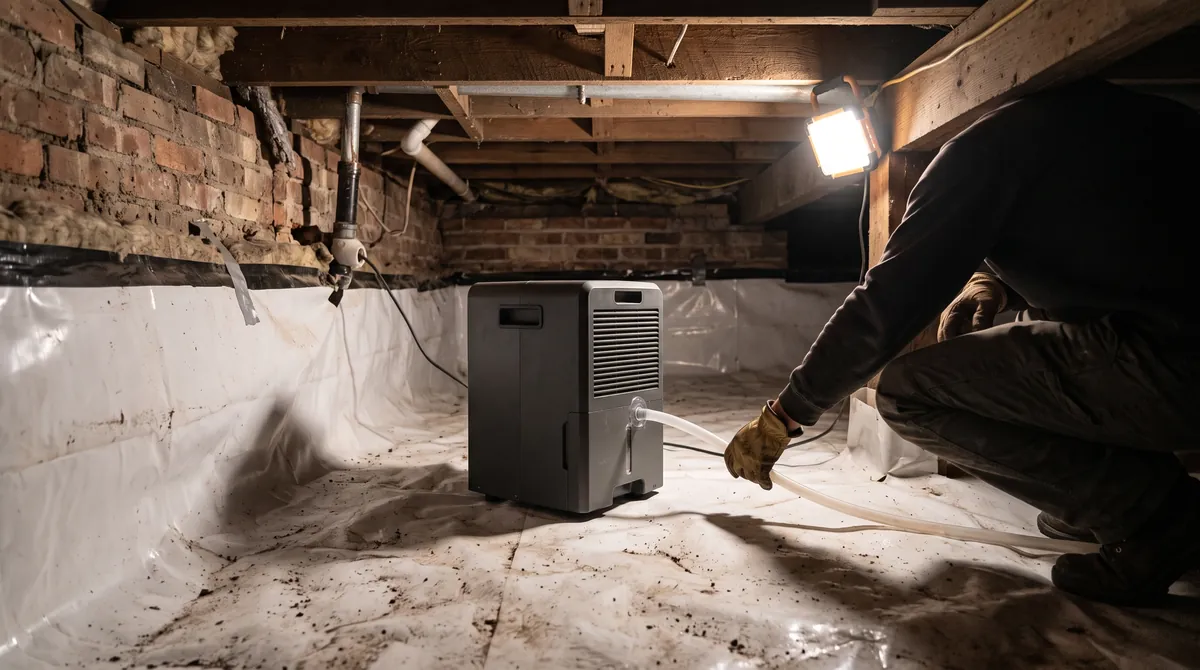
Crawl Space Dehumidifier Installation in Asheville
Crawl space dehumidifier installation in Asheville means we set a permanent unit that empties itself through a drain or condensate pump. The air stays drier, so the musty smell and sweating ducts clear up. A free quote shows you the price before you commit.
Where do I start with a crawl space dehumidifier?
Start by finding out how damp the air under your floor really is. We take a humidity reading before we set any unit. Then we check the vents, the dirt and any standing water. That tells us whether a unit alone will keep the air drier or the space needs closing in too.
Where does the dehumidifier's water go?
The water leaves through a drain line or a condensate pump, never onto the dirt under your house. A drain line is a hose that runs downhill through the rim joist to the outside. When the water can't fall that way, a small condensate pump pushes it up and out. The line can also empty into a floor drain or sump pit you already have.
What do you check under the house before setting a dehumidifier?
We check how the damp gets in and where the unit can drain and plug in. That means the vents, the ground cover or bare dirt, and any wet corners. We look for dripping pipes and the nearest outlet. We also want a spot near the middle, close enough to the rim joist that the water has a short way out.
Why the air under your house stays damp
Damp gets under a house two ways: in through the foundation vents, and up out of the dirt. On a humid summer day, outside air drifts in through the vents. It meets the cooler ducts, pipes and floor joists, the beams your floor rests on. Its water beads up on them the way a cold glass sweats.
Bare dirt adds more. Water in the ground rises as vapor all year. With nothing over it, that vapor goes straight into the air under your floor. You'll often notice it upstairs first: a musty smell, clammy floors, beads on the ducts or mold on the joists.
A dehumidifier pulls water out of the air itself. It works well in a crawl space that's already closed in, because there it's drying one pocket of air, not the whole outdoors. Some sealed crawl spaces still stay too humid, from damp in the foundation walls or a slow plumbing leak. That's when a unit earns its spot.
If your vents are still open, we'll talk with you about closing the crawl space in too.
Where the unit sits and plugs in
We've got two spots for the unit. Most often it sits level on a low stand on the ground cover, the plastic sheet laid over the dirt. Where that plastic is torn or missing, we can lay a new ground cover over the dirt on the same visit. If there's no room on the ground, or water runs through after storms, we hang it from the joists on straps instead.
We like it near the middle, so dry air reaches the far corners. It should also sit close to where the water can leave. We keep it out of the path anyone crawls to reach your pipes.
A permanently installed unit needs an outlet close by, so the nearest one helps decide where it goes. We won't leave it running off an extension cord across the dirt.
What happens to the water it pulls out
The water has to leave the crawl space, and a drain line is the simpler of our two ways out. That's a hose that runs downhill from the unit and out through the rim joist. The rim joist is the board that closes off the edge of your floor framing, just above the foundation.
We drill through the rim joist, angle the hose slightly down so the water keeps moving, and seal around the hole. When the unit sits lower than that hole, the water can't fall outside, so we add a condensate pump. It's a small pump that collects the water and pushes it up through tubing and out.
If you already have a floor drain or a sump pit, we can run the line there. A sump pump put in for waterproofing the crawl space often makes the easiest outlet.
How we choose a unit for your space
We choose the unit by looking at the crawl space itself, not by going off a chart. Floor area counts, and so does height. The bigger question is how sealed the space is. With the vents shut and the dirt and walls covered, far less damp gets in, so the unit has less to do.
We also look for what's feeding the damp. It might be a wet corner, a dripping pipe or puddles after a hard rain. Standing water is a different problem, and pumping it out and drying the framing comes before we set any unit.
A unit that's too small runs all day and never catches up. One that's far too big kicks on and off in short bursts and leaves the corners damp.
We set units under houses in Weaverville, in Swannanoa and out east in Black Mountain. West of the city we work in Candler, and to the south in Fletcher and Mills River. Farther down, we're under floors in Mountain Home and Hendersonville too.
Setting it up and making sure it's working
On install day we set the unit, drain it, power it and then watch the reading.
- We read the humidity under the floor and note the vents, the ground cover and any wet spots.
- We set the unit level on its stand or hang it from the joists. We leave room around it for air to move.
- We run the drain line through the rim joist, or hook up the condensate pump. Then we pour in water and watch it drain.
- We plug it in and dial in the set point. That's the humidity level the unit works to hold.
- We leave a humidity monitor down there, a little readout that tracks the air over time. Then we check that the reading drops.
Some units take a control you mount upstairs. You can watch the reading and change the set point without crawling under the floor. The seasons change what the space needs, so check it in a muggy summer and again in winter.
What changes the cost of putting one in
The cost comes down to the unit your crawl space needs and the work to set, drain and power it. The shape the space is in drives most of that.
- How sealed the space is. A closed crawl space asks less of the unit than open vents and bare dirt.
- Getting in and around. A tight access door or a low crawl space takes more time.
- Where the water goes. A short drain line is simpler than a condensate pump and a long run of tubing.
- Power at the spot. With no outlet nearby, adding one becomes part of the job.
- What has to come out first. We can't set anything on top of torn plastic, fallen insulation or junk. Cleaning out the crawl space is its own job.
Frequently asked questions
How much does it cost to install a dehumidifier in a crawlspace?
The unit, the drain route and any prep work move the price the most. A short drain line through the rim joist costs less than a condensate pump with a long run of tubing. A unit also costs less to run in a sealed crawl space, where it switches on far less than one pulling against open vents.
Is it a good idea to place a dehumidifier in a crawl space?
Yes, when the air under your house stays humid and the space is closed in. Sweating ducts, limp insulation and a musty smell upstairs all point to air that's too wet. With the vents wide open, though, the unit fights outdoor air all summer. So we look at the vents and the dirt before we recommend one.
Can I put a dehumidifier in my crawl space without encapsulation?
You can, but it'll work much harder than it should. Encapsulation means closing the crawl space in, with the vents shut and the dirt and walls covered. Without it, the unit keeps drying humid outside air and vapor from the ground. The reading may never come down. If your vents have to stay open for now, a humidity monitor will show you whether it's keeping up.
What size dehumidifier do I need for a 1500 sq ft crawl space?
Most crawl space units are rated somewhere between about 55 and 140 pints a day. Floor area alone won't tell you where yours falls. A crawl space sealed tight with the dirt covered needs far less than one the same size with open vents and wet ground. We look at the height, how closed in the space is and what's feeding the damp. Then we pick a unit that keeps up without running nonstop.
Noticing a musty smell or wet ducts?
Tell us what you've noticed. Maybe it's a musty smell, ducts beaded with water, or floors that feel clammy in summer. If you know whether the vents are open or the dirt is covered, mention that too. Asking Craggy Crawlspace for a quote is free, and you'll know what the job involves before you decide.
Send the form or give us a call, and a technician from around here will call you back to talk it through.