
Can a Dehumidifier Do the Job Without Sealing the Crawl Space?
In Asheville, a dehumidifier in a crawl space without encapsulation mostly dries the weather. Open vents let humid air in, and bare soil adds its own damp. Close the vents and cover the ground first, and a permanent unit with a drain can keep up.
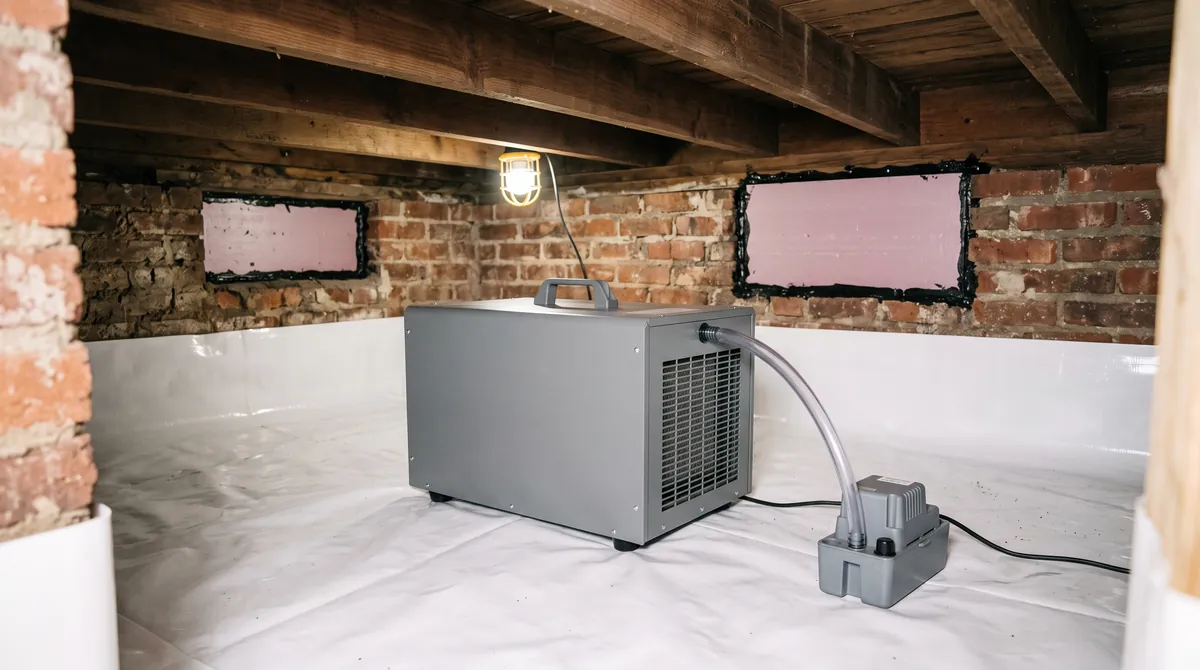
Under an older West Asheville house, the crawl space usually still breathes through open foundation vents. When the rooms above start to smell musty, a dehumidifier looks like the quick answer. It can help, but only if the air it dries stays put.
North Carolina treats the unit as one tool among several for a closed crawl space. In its code interpretation on closed crawl space moisture control, the NC Office of State Fire Marshal notes that the state's residential code contains five prescribed methods of moisture control. A permanently installed dehumidifier with a condensate pump or drain is one of them. Every one of them assumes the space is closed up first.
Does a crawl space dehumidifier work with the vents open?
It works poorly, because it spends all day drying fresh outside air. Summer humidity around Asheville pours back in through open vents as fast as a crawl space dehumidifier can pull it out. So it runs almost nonstop, and the joists stay damp. Once the vents are sealed and the ground is covered, the same unit can hold the air dry.
What has to happen before the unit goes in?
First we get any standing water out and fix its source. Then we clear out the old plastic, seal the vents tight, and lay a vapor retarder over the dirt and up the walls. Only after that do we set the unit level, run its drain and dial in the humidity control. Skipping those steps leaves a dehumidifier fighting water it was never meant to handle.
Why does bare dirt matter so much?
Bare soil gives off water vapor all the time, even when it looks dry. Under an older house on clay, that steady damp adds up to a lot of water over a season. A dehumidifier has to pull every bit of it out of the air. Covering the ground with a sealed vapor retarder stops most of it at the source.
Why a unit can't keep up with open vents
A dehumidifier pulls water out of the air around it. With the vents open, that air gets swapped out all day for muggy summer air from outside. Bare dirt keeps giving up water from underneath too. So the unit runs and runs, the joists stay damp, and the smell upstairs barely changes.
You'll see it under the house and in the rooms above:
- The unit hardly ever shuts off, even overnight.
- The musty smell comes back on every hot, wet day.
- Ductwork and cold-water pipes still sweat in July.
- Insulation between the joists stays damp or drops to the ground.
Many West Asheville bungalows from the ’20s sit on brick-on-clay foundations. Clay holds water against the walls and old brick soaks it up, so air under a house like that starts out wet before a single vent lets more in.
What we close up before the unit goes in
We start with readings, because the fix depends on where the water comes from. We check the relative humidity under the floor and test the rim joist and the subfloor for moisture. Then we look for standing water, open vents and bare soil.
On most houses we do it in this order:
- We pump out any standing water and find what's letting it in.
- We haul out the old plastic and any debris.
- We block off the vents and seal them so outside air stays out.
- Then we lay a vapor retarder over the dirt and carry it up the walls and piers.
- We mount a permanently installed dehumidifier level, with a condensate pump or drain.
- Last, we set the humidity control and watch the first water reach the drain.
Once the space is closed, the unit only has to dry the air that's already there. We size it by capacity, which is how many pints of water it pulls from the air in a day. An efficient model pulls the same water on less power.
Is a dehumidifier alone ever enough?
Sometimes it's enough for a while. If the dirt is already covered and there aren't many vents, a unit can bring the humidity down and buy you time. It can't fix standing water, and it can't stop outside air pouring through open vents.
If there's water lying on the ground, we fix the drainage first, every time. An outlet near where the unit will sit saves running new power. A floor drain close by keeps the drain line short, while a long run needs a condensate pump.
Before we come out, take a look from the access door. Are the vents open or blocked, and is the ground covered or bare? Note any puddles, sweating pipes or sagging insulation, and tell us which rooms smell worst.
Close it up, then dry it
A dehumidifier earns its keep in a crawl space that's sealed from outside air. Get the vents closed and the ground covered before you count on one. Our crawl space dehumidifier installation covers the unit, the drain and the humidity control. If the vents and the dirt need work first, Craggy Crawlspace takes care of that part too.
Frequently asked questions
Will a dehumidifier run all the time if the vents stay open?
Yes, it'll run close to nonstop through the summer. Every open vent lets in fresh humid air, so the unit is drying air that keeps getting replaced. You pay for the power, the unit wears faster, and the joists may still read damp. If yours never hits the humidity you set, the space isn't closed up yet.
Can I close the vents and leave the dirt bare?
Closing the vents helps, but bare dirt keeps sending water vapor into the air. With the vents shut, the dehumidifier ends up trying to dry the dirt itself. A vapor retarder over the ground cuts most of it off, as long as the seams overlap and it runs up the walls and piers. Do both, and the unit has a lot less water to chase.
Does a portable dehumidifier on the dirt do the same job?
It'll help a little, but not for long. A portable unit sitting on the dirt usually drains into a bucket that fills fast. It isn't built for a damp crawl space, either. A permanently installed dehumidifier sits level, drains to a floor drain or a condensate pump, and runs off a humidity control. That's the setup we put in.
What should I check before calling about a dehumidifier?
Start upstairs by noting which rooms smell musty and when it's worst. Then take a flashlight down to the access door. Look for standing water, open vents and bare dirt, since each changes the plan. Check for an outlet near where a unit could sit, and for a floor drain or an existing condensate pump.
Noticing a musty smell or wet ducts?
Send the form or give us a call, and a technician from around here will call you back to talk it through.