
The Downsides of Encapsulating a Crawl Space in Asheville
Encapsulating a crawl space in Asheville has real drawbacks. You'll need a permit, and a dehumidifier that runs for good and drains through a condensate pump. The liner tears if it's handled roughly. Weigh each one against your own house before you decide.
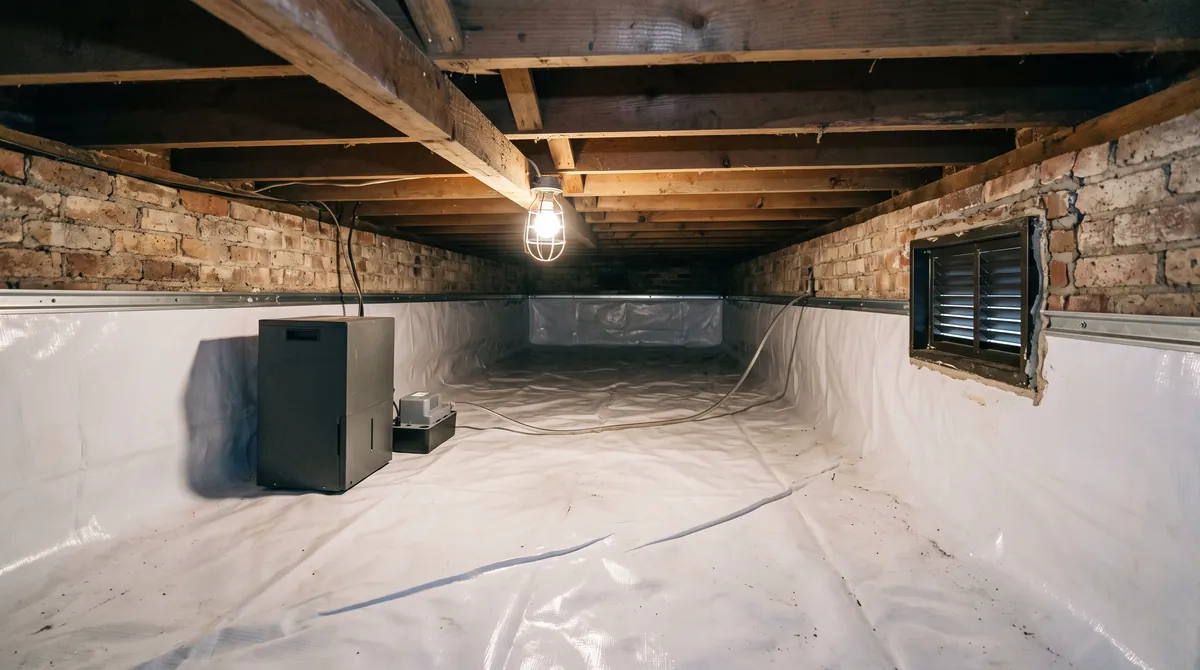
A lot of older houses around Asheville sit over vented crawl spaces. Sealing one changes how the whole floor deals with damp. It's often the right fix for a musty smell, sweating ductwork or batts sagging off the joists. But it swaps one set of problems for a smaller set you'll live with, and floodplain ground adds one more.
Some of the trade-offs come from the rules, not the work. How we dry your crawl space can decide who works on it. The NC Office of State Fire Marshal says the license the job needs depends on how the space gets dried.
Will I need a permit to encapsulate my crawl space?
Plan on a permit when encapsulating a vented crawl space in Asheville. The state requires it to close up a vented space, whatever the job costs. The whole conversion goes under a single permit. Ask about it each time you compare estimates.
What upkeep does a crawl space dehumidifier need?
A crawl space dehumidifier needs little upkeep, but it can't be ignored. Clean or change the filter when it looks gray. Make sure the condensate pump or drain is still carrying water away. Glance at the humidity reading on its control now and then. If the reading creeps up and stays there, the unit, its drain or a tear in the liner is usually the cause.
Can I seal a crawl space on a lot that floods?
It's doable, but ground that floods limits how tightly the space can be sealed. Where floodwater can reach it, we leave the flood vents in place so water flows through instead of pushing against the foundation. We pair that with a pump to clear standing water and a dehumidifier with room to spare. After any flood, we check the liner and insulation first.
The trade-offs of a sealed crawl space
The main drawback never ends. A sealed crawl space needs drying every day, for as long as you own the house. Once we close the vents and seal the liner, damp air can't drift out anymore.
That's why many jobs end with a permanently installed dehumidifier with a condensate pump or drain and its own outlet. It runs on your power bill. When it stops, the humidity under the floor climbs.
The other drawbacks come from paperwork and from the liner itself.
- Permit time. Turning a vented crawl space into a closed one takes a permit, whatever the job costs, so plan on it from the start.
- A liner that needs care. A tear from a dropped tool or a dragged box lets ground moisture back in.
- Harder trips underneath. Plumbers, electricians and pest crews have to work on top of the liner. Not all of them treat it gently.
- Floodplain permits. If your lot sits in the floodplain, the City of Asheville wants a permit for any building or rebuilding on it. Check with the city before you book the job, so it doesn't stall on paperwork.
Ask us what the dehumidifier will add to your power bill, so you know the running cost going in.
How we keep the downsides small
First we measure. We take humidity readings under the floor and test the rim joist and floor joists for moisture. That shows how hard the drying has to work. It also rules some options out before you pay for them.
There are several ways to keep a closed crawl space dry. Each one leaves different upkeep behind.
- A dedicated dehumidifier. It sits on the liner and empties through its pump or line. It's the one piece you'll hear cycling.
- Supply air from your air conditioning. We duct a little conditioned air down from the house's system and fit a backflow damper so crawl space air can't get into your ducts. It only dries while the system runs.
- An exhaust fan. We fit a fan that pushes crawl space air outside. That draws house air down to replace it.
- Conditioned space. We design the crawl space as part of the heated and cooled house, so we insulate the walls instead of the floor.
Supply air and conditioned space both tie into your heating and cooling. We'll tell you which way fits your house and what it asks of you afterward.
We lay a full interior liner sealed to the walls and columns, with every seam overlapped and taped. A tear later is a patch, not a new liner. Where the unit allows it, we mount its humidity control inside the house. You can check the set-point and the reading without crawling under.
Is sealing still worth it on your lot?
On a dry, level lot, the downsides above are usually all there is. Sealing makes less sense where water gets in faster than anything can take it out. If storms leave standing water on the dirt floor, we fix that first. That usually means a sump pump where the water gathers, plus a battery backup if your power drops in storms.
Flood-prone ground is the harder case. On a lot that floods, we keep flood openings in the foundation walls so floodwater can flow in and out on its own. With holes built in on purpose, the space never gets as tight as one on high ground, and the dehumidifier works harder.
If money is tight, a polyethylene ground cover over the dirt floor is worth doing either way, vented or sealed. We can lay that first and seal the rest later. Leave it down for a season and you'll see how damp the space really runs and whether it needs sealing at all.
Before we come out, jot down where you've seen water after storms and what's stored under the house. Both change the plan. Anything stored down there has to move before we lay the liner.
Weigh the trade-offs before you seal
If the upkeep, the permit and some care for the liner sound manageable, sealing usually leaves you with a drier floor that doesn't smell like dirt. If your lot floods, sort that out first. We go through the job start to finish on our crawl space encapsulation page. The rest of what we handle below the floor is at Craggy Crawlspace.
Frequently asked questions
What are the negatives to crawl space encapsulation?
The main ones are upkeep and paperwork. Something has to keep drying the space, either a machine or your heating and cooling, so there's a running cost and a part that can fail. The paperwork is the permit you'll need to seal a vented space. The liner needs looking after whenever someone works under the floor, and on ground that floods it can't be closed up as tightly.
What if the dehumidifier quits?
The humidity starts creeping back up, and in a closed crawl space it has nowhere else to go. That's why we like a control you can read from inside the house. If the number climbs, look at the drain first. A clogged line or a full condensate pump is a common reason a unit shuts itself off, and both are quick to clear.
Can I still store things in a sealed crawl space?
You can, as long as nothing sits right on the liner or gets dragged across it. Set boxes on a board or a pallet and keep sharp corners off the plastic. Leave a clear path to the access door and the dehumidifier. If something punctures the liner, we tape over the hole, so take a look whenever you're down there.
Can a plumber still work under a sealed crawl space?
Yes, and the liner doesn't stop them. Ask them to go easy on it and to tell you if they cut or lift any of it to reach a pipe. A cut seam is a quick fix when it's caught that day. Left open, it lets ground moisture back under your floor, and you won't notice until the humidity reading moves.
Want to see what yours would cost?
Hit the call button or send the form, and a local technician will call you back to talk through your house.